

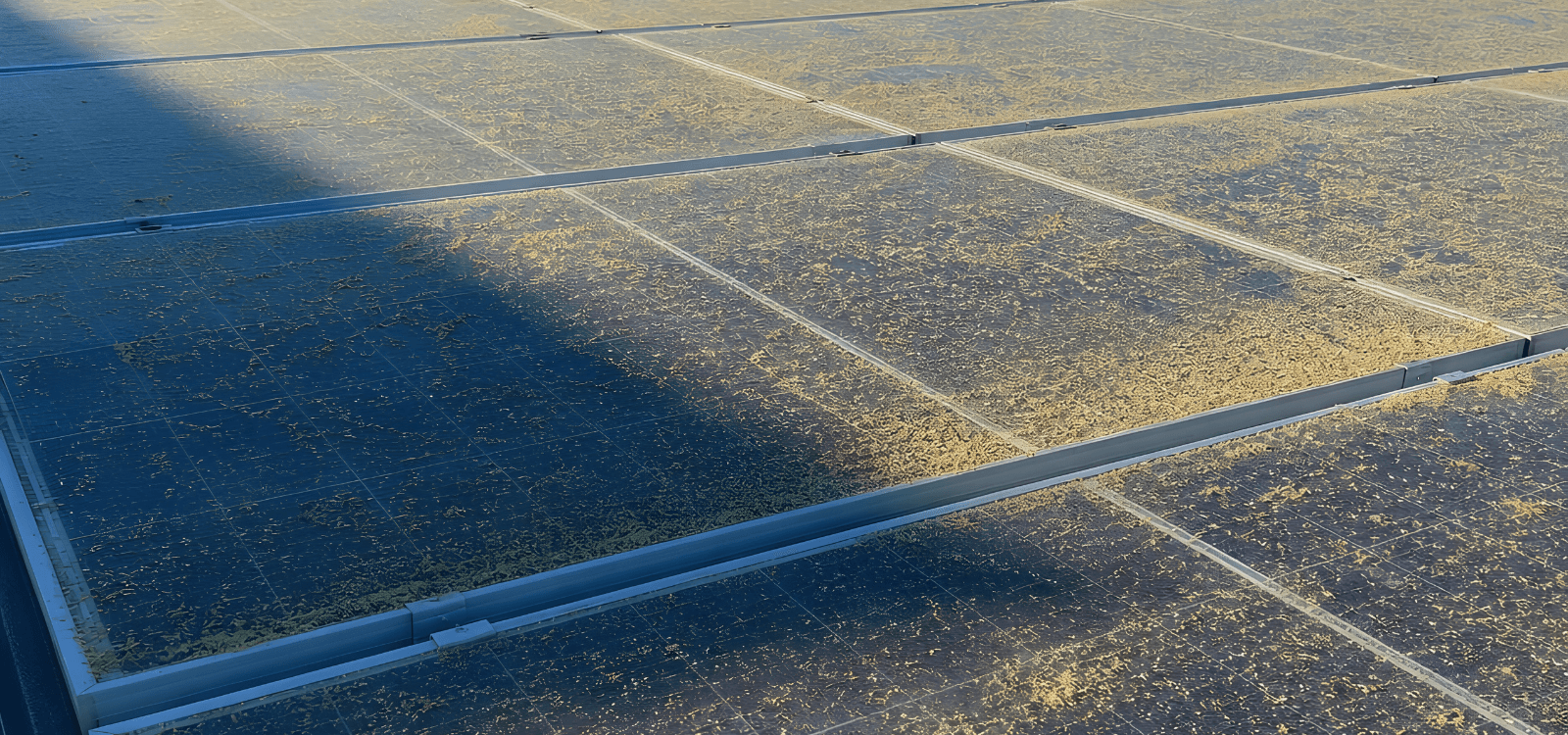
Commercial solar degradation is rarely one failure. Pests, moisture, soiling, and deferred maintenance compound until output quietly drops.
A commercial solar system rarely fails in a single dramatic moment. It gets quietly worse, one season at a time, until production looks nothing like it did at commissioning.
That is the part that catches owners off guard. There is no outage, no alarm, no phone call from anyone — just a slow drift downward that nobody can put a date on.
Most of these systems run for decades with almost nobody looking at them. Rarely is someone driving out to a rooftop or a ground-mount array that has been producing year after year. Why look closer when the system is still generating?
In that gap, real things happen. Almost none of them have anything to do with how good the panels are.
What Actually Causes a Commercial Solar System to Degrade?
Commercial solar degradation is almost never one failure. It is the accumulation of small, unmonitored problems — pests, loose connections, moisture, and soiling — stacking on top of the panels' natural annual output loss.
Each item on its own looks minor. Together, across years of deferred maintenance, they compound into a number the owner cannot explain.
- ●Pests. Rats chew through wiring. Birds find an inverter casing warm and dry and decide it is a perfect place to nest.
- ●Loose connections. A connector that was hand-tightened when the system was installed slowly works loose over years of thermal expansion and contraction. Nobody notices until it is affecting production or the string disconnects completely.
- ●Water intrusion. After heavy rain, water finds places it should not. Cables, connectors, and other electrical components sit exposed to moisture for years, sometimes in standing puddles — which is a safety and liability problem before it is ever a production problem.
- ●Soiling and corrosion. Pollen, dirt, dust, rust, and corrosion build up season after season, gradually reducing the amount of power the system generates.
- ●Natural panel degradation. The modules themselves lose a small percentage of output every single year. Long-term field data shows panels last well past their warranty, but the slow decline is real, and it is physics rather than neglect.
None of this is dramatic. None of it triggers an alarm. It just sits there, degrading a little more every season.
Why Doesn't Anyone Notice Until the Numbers Are Bad?
Gradual loss is invisible day to day, because no single day ever looks meaningfully worse than the one before it.
Degradation does not produce a step change. There is no moment where the system goes from fine to not fine, so there is no moment that prompts a phone call.
That is compounded by how thinly these assets are watched. Monitoring portals go stale when the installer moves on, logins get lost with the employee who set them up, and alert emails route to an inbox nobody reads anymore.
Even when the data is available, catching a slow decline takes deliberate analysis rather than a glance at a dashboard. Researchers have built methods to detect underperformance from inverter data alone precisely because the drop is too subtle to see any other way.
So the loss registers as a feeling instead of a fact. The owner knows the system feels lower than it used to, if they are paying attention at all.
How Much Output Can a Neglected System Actually Lose?
Enough to change the economics of the asset entirely. A system running at 90% of expected output five years ago can be running near 60% today, and it happened slowly enough that nobody watching day to day ever saw a single moment where it got worse.
The gap between "still producing" and "producing what it should" is where the money goes. A system at 60% is still on, still visible from the parking lot, still technically working.
That is what makes compounding degradation different from a failure. A failure gets fixed because it demands attention. A slow decline just gets absorbed into the utility bill.
What Is the Difference Between Normal Degradation and Deferred Maintenance?
One is expected and priced into the project. The other is avoidable and is not.
- ●Expected degradation. The gradual, predictable output loss engineered into the module itself. It was in the pro forma on day one, and there is nothing to do about it except plan for it.
- ●Avoidable degradation. Soiling, pests, water intrusion, loose terminations, failed strings, and a dead tracker nobody replaced. None of this was in the model, and all of it compounds on top of the expected curve.
The trouble is that the two are indistinguishable from the outside. Production is down, and without an inspection there is no way to know how much of the shortfall is physics and how much is a rat in the junction box.
That matters because the second category keeps growing while it is ignored. A loose connector eventually becomes an arc fault. Moisture in a combiner eventually becomes a failed inverter and a painful replacement quote.
What Does Waiting Another Year Actually Cost?
The cost of waiting is not hypothetical, and it is not a scare tactic. The damage is already in the system today.
It is a rat that is already in the junction box. It is a bird's nest that is already in the inverter. It is a connector that is already loosening.
The system does not reset itself while you wait. It just keeps degrading, whether anyone is watching or not — and every season of deferral makes the eventual remediation scope larger and more expensive.
What Are the Options for an Aging, Underperforming System?
An owner facing a system in this condition has three realistic paths, and the right one depends on how much appetite there is for taking on the work.
- ●Inspect and remediate. Bring in an O&M provider, get eyes on the equipment, and fix what has accumulated. This restores real output, but it means commissioning an inspection, absorbing an unknown repair bill, and standing up a maintenance program that should have existed all along.
- ●Repower. Replace the aging equipment — usually inverters first — and reset the asset's clock. Repowering is becoming a core strategy for America's aging solar fleet, though it is a capital decision, not a maintenance one.
- ●Sell the system as-is. Hand off the asset in the condition it is actually in, and let someone else take on the degradation, the deferred maintenance, and the unknowns.
If the system has reached the point where none of the options feel obvious, that is usually a sign it has crossed into midlife territory, where the decision is about the asset's future rather than this season's production.
Start With What the System Is Worth Today
Most owners in this position have not been negligent. They inherited a system, or bought a building with one on the roof, or simply had it fall down the priority list behind everything else the business needed — which is exactly how a system ends up quietly costing money every month it sits there.
We buy systems in exactly this condition. Degraded, unmaintained, soiled, and quietly worse than anyone realizes. You do not need to inspect it or fix it first — we take it as-is, at the condition it is actually in today, so you can move on without taking on the work yourself.
If the system is aging, underperforming, or just in the way, the fastest way to know where you stand is to find out what the project may be worth as-is. We buy existing solar projects across the Northeast US and pay you for them.
Ready to Discuss Your Project?
Get your instant estimate or talk to our team about your legacy solar project.


